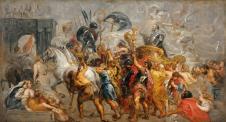
"The Coronation of Marie de' Medici," Peter Paul Rubens, 394 cm × 727 cm, 1622~1625, Louvre Museum.
The theme of both paintings is the coronation of the French royal family. The former is more famous due to the importance of its protagonist and historical event, while the latter is also a masterwork. "The Coronation of Napoleon" depicts Napoleon being crowned emperor by the Pope in 1804, with the scene frozen at the moment Napoleon places the crown on Empress Joséphine, set at Notre-Dame de Paris. David was a representative painter of Neoclassicism and painted many portraits of Napoleon, including some masterpieces.
"The Coronation of Marie de' Medici" depicts the coronation of Marie de' Medici, queen of Henry IV. Due to Henry IV's earlier assassination, Marie was declared regent and crowned queen (a queen's coronation was not obligatory; Marie was the only queen of the Bourbon dynasty to be crowned), set at the Basilica of Saint-Denis (the traditional site for queen coronations). Rubens was a representative painter of the Baroque and Marie's court painter, creating a series of decorative paintings for her at the Luxembourg Palace. The similarities between these two paintings are self-evident: they share the same composition and the same order of figures (though the traditions of coronation must also be considered).
The focal point of both paintings is the person being crowned, who is a queen/empress. On the right are clergy, followed by a group of attendants behind the person being crowned, and further back and in the background are dignitaries attending the ceremony. In terms of spatial sense and grandeur, David's painting is larger, also having a larger size and more figures. Being a post-Revolution painting, David's work lacks the cherubs in the upper middle and the pet dog in the lower right found in Rubens' painting.
However, it is worth noting why David chose the moment of Joséphine's coronation to depict Napoleon's coronation. As is well known, the most dramatic moment of Napoleon's coronation was when Napoleon did not let the Pope...