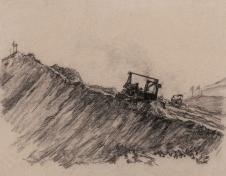
A slash of burnt umber scaffolding cuts diagonally across the sheet—dry, urgent, alive with the tremor of a charcoal sketch made just before rain. Two gentlemen stand calmly within this chaos: powdered wigs catching light, waistcoats rich with the deep, resonant red that defines Carl Larsson’s most deliberate chromatic statements. This is not decorative colour—it’s structural, emotional, almost architectural in its weight and placement. Their crimson coats burn with quiet insistence, held aloft by layers of translucent watercolour: first a lean underpainting in diluted ochre, then successive veils of vermilion mixed with binder-rich gum arabic, finally crowned with pinpoint strokes of titanium white so thin they read as breath on fabric.
Larsson’s palette here operates like a finely tuned ensemble—red, grey, white, and ochre never compete but converse in measured intervals. The greys alone reveal his preoccupation: cool variants laced with ultramarine whisper of steel and sky; warmer tones stirred with burnt sienna echo sun-baked brick and dust; and the palest greys emerge not from pigment alone, but from the paper’s own tooth, lightly brushed with lead-white washes that leave the surface subtly luminous. That red, though—so vivid yet so grounded—carries his deepest interest: the dignity of presence amid flux. He doesn’t stage irony or satire when placing 18th-century elegance beside raw construction; instead, he renders both with equal tenderness and precision, trusting the viewer to feel the gravity of continuity rather than the shock of contrast.
The watercolour medium becomes an active agent in this vision—its fluidity softening edges, its transparency allowing history and immediacy to coexist in the same atmospheric space. Look closely at the shadow beneath a sleeve: a whisper of Prussian blue and burnt umber, laid down wet-into-wet and then partially lifted, leaving a residue that feels both ancient and fleeting. Meanwhile, the satin sheen of a waistcoat belt is built with dry-brush scumbling—barely any pigment, just the drag of bristles catching paper ridges—to suggest texture without solidity. In this way, Larsson’s technique mirrors his subject: the physicality of paint—its thickness, its bleed, its resistance—becomes a metaphor for how identity holds steady even as the world around it rises, shifts, and reassembles itself.