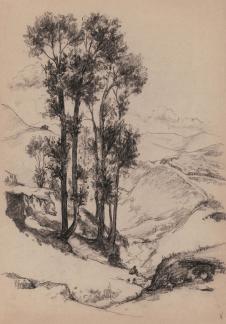
Sunlight doesn’t fall here—it *settles*, thick and golden, into the fissures between stone and shadow. The Hakata Path is empty of figures, yet thrums with quiet pulse: a breath held, a leaf trembling at the edge of stillness. Giovanni Giacometti doesn’t depict a place you walk through, but one you step *into*—a threshold where light becomes tangible, and shade acquires weight and warmth.
His handling of paint is visceral, urgent, alive. Near the foreground, stone steps erupt from the canvas in thick impasto—layers of burnt umber and violet-red built up with knife and brush, scraped back to reveal ghostly traces of underpainting like weathered limestone catching late sun. Tree trunks rise with long, vertical strokes that drag slightly, leaving raw canvas or pale ground exposed at their edges—less like solid forms than silhouettes drawn by absence. But it’s in the canopy that his color technique sings: dense clusters of cobalt and olive green applied in rapid, staccato dabs, overlaid with translucent scumbles of yellow-green, while sudden flashes of dried crimson aren’t highlights but *exposures*—areas where wet paint was scraped away to reveal warm underlayers, like sunlight igniting veins in a leaf. This constant interplay of thick and thin, opaque and luminous, dry and wet, keeps the surface humming with unresolved energy.
The mood is paradoxical—serene yet electric, still yet vibrating. There’s no breeze, yet the foliage feels charged, as if holding its breath before a shift in light. The palette—anchored in deep blues and mossy greens, pierced by earthy reds and sunlit yellows—doesn’t mimic nature so much as translate its emotional resonance: coolness that comforts, warmth that stings, shadow that shelters and surprises. Giacometti’s expressionist language isn’t about distortion for drama, but about intensifying presence—every stroke, every scrape, every juxtaposed hue serving to make the ordinary extraordinary, turning a city footpath into a site of quiet revelation, where pigment and poetry converge.