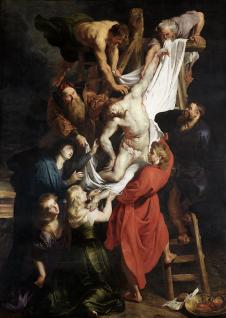
A stark, searing silence radiates from Rembrandt’s *The Trinity Cross*, a masterful etching that distills sacred agony into pure graphic intensity. Far removed from the luminous oil paintings for which he is best known, this work harnesses the raw, incisive power of black-and-white etching—ink biting deep into copper, light emerging not through pigment but through the absence of line. At its heart stands Christ on the central cross: not idealized, not triumphant, but profoundly human—his body attenuated, ribs visible beneath taut skin, head bowed in exhausted surrender. Flanking him, the two thieves hang in parallel suffering, their postures asymmetrical yet unified by shared gravity and quiet despair. Below, a compressed crowd gathers—not as witnesses, but as participants in grief, their faces buried, shoulders hunched, robes carved from dense, turbulent hatching that seems to writhe with suppressed lament.
Rembrandt’s compositional rigor here is both architectural and psychological. The vertical thrust of the three crosses anchors the image like a grim triptych, while the low horizon line forces the viewer into the throng’s vantage point—intimate, unflinching, almost claustrophobic. Light does not illuminate; it isolates. A single, directional source carves Christ’s torso from shadow, casting his arms into stark relief while plunging the thieves’ faces into near-oblivion—a deliberate hierarchy of visibility that underscores theological emphasis without didacticism. This dramatic chiaroscuro, so characteristic of Baroque religious art, is rendered not with brushstrokes but with needle and acid: each line varies in weight, depth, and tremor, lending the figures palpable breath and vulnerability. The crossbeams act as subtle diagonals, guiding the eye upward toward the crucified, then downward again into the vortex of mourning below.
The palette—strictly monochrome—is not a limitation but a revelation. Black is neither empty nor passive; it is atmospheric, velvety, charged with spiritual weight. White space is never neutral—it is breath, divinity, the void against which sacrifice gains meaning. Rembrandt exploits the full tonal range of etching: from the burnished, almost metallic sheen of Christ’s illuminated flank to the suffocating density of the background, where darkness feels less like absence and more like presence—an enveloping, sacred night. His handling of texture is extraordinary: the coarse weave of mourning garments emerges through clustered, agitated lines; the smooth tension of stretched skin appears in long, clean contours interrupted only by the faintest tremor of fatigue. There is no ornament, no distraction—only form, force, and feeling distilled to their essence.
This etching belongs unmistakably to Rembrandt’s late period, when his vision grew inward, his technique bolder, his empathy deeper. Unlike earlier Dutch religious prints steeped in narrative clarity or allegorical flourish, *The Trinity Cross* strips away anecdote to confront the elemental: sacrifice, solidarity in suffering, the unbearable dignity of endurance. It resonates with the emotional austerity of his late self-portraits and the hushed gravitas of *The Return of the Prodigal Son*, yet speaks a language uniquely suited to the etcher’s medium—immediate, intimate, unforgiving. Its enduring power lies not in doctrinal instruction but in visceral communion: the way a single, deeply incised line can suggest a sob caught in the throat, or how negative space can evoke the weight of divine silence. Few works in the history of printmaking achieve such monumental solemnity with such economical means—and fewer still invite sustained, silent looking the way this one does.