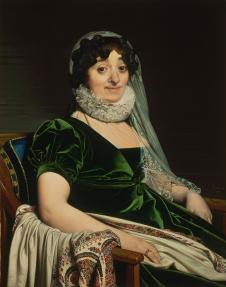
A commanding stillness radiates from the figure—tall, upright, and self-possessed—standing before a classical garden fountain whose arcing water seems to pause mid-air in deference to his presence. This is not mere portraiture; it is ceremonial embodiment, a distilled moment of aristocratic gravity rendered with the precision of a sculptor and the psychological acuity of a master observer. Dominique Ingres, though often associated with idealized nudes and mythological scenes, here turns his exacting gaze toward the living architecture of power: the Duke of Orléans, heir to the French throne, presented not as a distant sovereign but as a man calibrated between tradition and modernity.
The composition balances rigorous geometry with subtle human warmth. The duke’s vertical axis anchors the canvas, his posture echoing the clean lines of the fountain’s stone basin and the clipped hedges receding into soft-focus depth. Yet Ingres refuses rigidity—the slight tilt of the head, the relaxed set of the shoulders beneath that impeccably tailored black-and-red uniform, the gentle fall of light across the medal ribbons—all introduce quiet vitality. His hands rest naturally at his sides, one gloved, one bare, a compositional counterpoint that draws the eye downward just long enough to register the delicate spray catching gold highlights before returning, inevitably, to the face: composed, intelligent, watchful.
Ingres’s technique is a marvel of controlled virtuosity—each brushstroke subservient to form, yet never mechanical. The red of the uniform glows with a deep, velvety intensity, its richness heightened by the stark black lapels and the luminous white of the cravat. Gold embroidery catches the ambient light like captured sunlight, while the medals—rendered with almost microscopic fidelity—emit a subdued, dignified sheen, their weight implied not by shadow alone but by the way they subtly compress the fabric beneath them. The background is neither generic nor incidental: the fountain’s graceful parabola mirrors the curve of the duke’s shoulder line, binding figure and setting into a single harmonic structure rooted in neoclassical ideals of order, proportion, and moral clarity.
This portrait stands apart in Ingres’s oeuvre—not for its departure from his principles, but for how fully it realizes them in a contemporary, secular context. While his contemporaries chased Romantic drama or historical spectacle, Ingres elevated the present moment through restraint, letting authority speak through posture, palette, and poise rather than allegory or gesture. The red-and-gold-white triad evokes both royal lineage and revolutionary-era military distinction, a visual synthesis of Bourbon heritage and post-Napoleonic legitimacy. Viewers today still feel the quiet pressure of that gaze—the unblinking composure, the sense of history held in balance—and understand why this work remains a benchmark of neoclassical portraiture: not cold perfection, but humanity refined to its most resonant, enduring form.