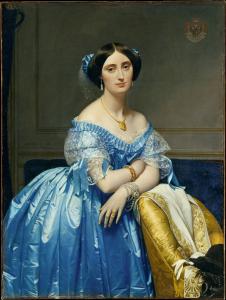
A quiet gravity emanates from Madame Lebrun—not through dramatic gesture or theatrical lighting, but in the absolute stillness of her posture and the unflinching composure of her gaze. Seated with regal ease, she occupies the center of the canvas like a classical bust brought to life: her black gown anchors the composition in solemnity, while the vibrant, almost Byzantine opulence of her shawl—woven with gold threads, burnt orange motifs, and ivory flourishes—introduces a subtle counterpoint of warmth and worldly distinction. This is not portraiture as social document alone; it is neoclassical idealism refined through the lens of Parisian haute société in the early 1800s.
Ingres orchestrates the space with masterful economy. The background recedes into soft, atmospheric neutrality—no architectural clues, no symbolic props—so that every visual weight falls on the figure’s presence and the exquisite tension between restraint and ornament. Her hands rest with quiet authority in her lap, fingers elongated and poised, their delicate articulation a testament to Ingres’s lifelong obsession with line as both structural armature and expressive instrument. The contours of her face, shoulders, and sleeves are rendered with a limpid clarity that borders on the sculptural, yet never at the expense of organic warmth; even the sharpest edge yields gently to shadow, revealing his deep understanding of tonal transition and the human form’s subtle topography.
The palette is deliberately austere yet resonant: deep velvety black dominates the dress, acting as a luminous void against which the shawl’s chromatic intensity flares—gold not as gilding but as light made tangible, orange not as heat but as dignified vitality, white not as purity but as refined contrast. Light falls with gentle insistence across her forehead, cheekbone, and the curve of her collar, modeling form without casting harsh drama—a hallmark of Ingres’s mature style, where chiaroscuro serves serenity rather than psychological intensity. His brushwork remains nearly invisible in the flesh tones, a seamless skin of pigment, while the shawl’s patterns emerge through meticulous glazing and fine linear incision, merging oil painting technique with the precision of a draftsman’s silverpoint.
This portrait stands apart in Ingres’s oeuvre not only for its arresting synthesis of austerity and splendor but for its quiet subversion of neoclassical convention: Madame Lebrun is no allegorical muse nor mythological heroine—she is emphatically herself, a celebrated artist, writer, and salonnière whose intellect and autonomy pulse beneath the surface calm. Her stillness feels volitional, not passive; her elegance is earned, not inherited. Painted in 1805, shortly after Ingres’s return from Rome and during his most rigorously disciplined phase, the work distills his belief that true beauty resides in harmonious proportion, unbroken rhythm, and the sovereign dignity of the individual. It remains a touchstone of French neoclassical portraiture—less about likeness as transcription, more about presence as revelation.