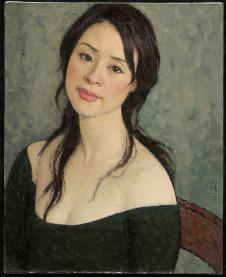
A quiet gravity emanates from the figure’s profile—her dark hair drawn back with classical restraint, her gaze lowered as if absorbed in private reflection. This is not a portrait of social display or aristocratic assertion, but one of inward composure, where stillness becomes its own kind of eloquence. Jacques Raymond Brascassat, though best known for his animal paintings and Romantic landscapes, reveals here a rare and luminous sensitivity to human presence—a departure that underscores his versatility beyond the more flamboyant currents of French Romanticism.
The composition is deliberately austere: no ornate backdrop, no symbolic props, only the woman’s head and shoulders emerging from a muted, earth-toned void. Her pose—slightly turned, neck elongated, chin gently tucked—recalls antique Roman busts, yet her flesh feels palpably alive, not carved in marble. Brascassat anchors the image through subtle asymmetries: the soft curve of her ear against the sharper fold of her collar, the delicate tension between the smooth plane of her cheek and the textured weave suggested in her garment’s yellow-and-white fabric. Light falls with hushed precision—not dramatic chiaroscuro, but a tender, diffused illumination that models form without harsh contrast, allowing shadow to gather like breath at the hollow of her throat.
His brushwork walks a poised line between finish and suggestion. Facial features are rendered with quiet exactitude—especially the fine gradations around her eyes and mouth—while the drapery dissolves into broader, almost atmospheric strokes where pigment thins and merges. The palette is restrained yet resonant: warm ochres and creamy whites dominate, softened by underlying tones of burnt umber and dove-gray. This chromatic economy avoids ornamentation, instead cultivating an aura of dignity and timelessness—less about opulence than about essence. There is no overt symbolism, yet the choice of Roman allusion, the dignified posture, and the absence of contemporary fashion all gesture toward ideals of civic virtue and stoic grace rooted in antiquity.
Brascassat’s *Portrait of a Roman Woman* stands apart within his oeuvre—not as a commission-driven likeness, but as a distilled meditation on presence and poise. It bridges Romantic sensibility—its emphasis on individual interiority and emotional authenticity—with a neoclassical reverence for line and proportion. Viewers encounter not just a face, but a threshold: between observation and empathy, between historical reference and quiet immediacy. Its enduring resonance lies precisely in this duality—technically assured, emotionally reserved, and deeply humane. For scholars of nineteenth-century portraiture and enthusiasts of Romantic-era oil painting technique, it remains a quietly revelatory work, where restraint becomes revelation.