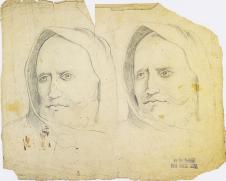
A stark, unflinching presence emerges from the canvas—not through idealization, but through the sheer physical weight of pigment. Albin Egger-Lienz builds the peasant woman’s face with dense, sculptural strokes of burnt umber and raw sienna, layering impasto on cheekbones and jawline until the surface itself seems to bear the labor etched into her expression. That rightward slash of light doesn’t illuminate so much as incise—carving a sharp diagonal that forces the eye downward from furrowed brow to parted lips, then locking it, inevitably, into the luminous intensity of her dark-rimmed eyes.
The composition rejects spatial retreat: no background, no shoulder, no context—only the face, cropped tightly, its contours acting as hard edges that contain and direct vision. Egger-Lienz’s restrained palette—grounded entirely in earth tones, with blackened greys scumbled thinly across shadowed hollows—creates a somber, tactile gravity. Yet within that austerity, subtle shifts occur: a faint warmth pulses in the sunlit clay of her temple, while the thickly painted highlights catch light like worn stone, giving the whole image a quiet, rhythmic breath beneath its austere surface.