This artwork may be protected by copyright. Download is for study & reference only — not for commercial use. If you are the rights holder and object to its display, click here to report and we will remove access within 24 hours.
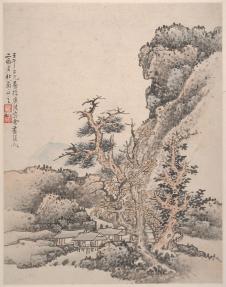
Ming Dynasty, Lan Ying, Evening Verdure of Pine and Vine, ink and color on paper, 160x55 cm, collection of Tianjin Museum. "Evening Verdure of Pine and Vine" hanging scroll is a Chinese painting by Lan Ying at age 38. The painting features layered peaks, with a temple nestled in dense pine forests in the middle, half-hidden and half-revealed, creating a delightful contrast.
Spring water flows along winding mountain streams, cascading down to connect with the river at the foot of the mountain. In the foreground, by the river, mixed trees form a forest, with an old man walking through it, followed by a boy carrying a qin. The composition uses the "high-distance" perspective, giving a majestic atmosphere. The texture of the rocks employs "lotus leaf texture strokes" combined with "axe-cut texture strokes," with moist ink and alternating shades, fully expressing the layering and volume of the green mountains.
Moss dots in mineral green are sparsely and tastefully applied, with bright colors, adding decorative interest to the painting. The forest is tall and straight, with aged branches; leaves are painted with a combination of dots and outlines, using mineral blue and mineral green for coloring, while some trees are bare of leaves, presenting an autumn scene. The entire painting features meticulous brushwork and steady ink tones, giving the viewer a sense of sparse and natural beauty.
Inscribed in running script: "Evening Verdure of Pine and Vine," signed: Autumn of the Renxu year, Qiantang Lan Ying, with two seals. The entire painting features meticulous brushwork and steady ink tones, giving the viewer a sense of sparse and natural beauty. "Listening to the Spring in a Spring Pavilion," with its professional style of in-depth depiction, and the "Evening Verdure of Pine and Vine" hanging scroll, also painted in 1622, better represent the main direction of Lan Ying's exploration.
In the painting, Lan Ying only deeply depicts the rugged rocks at the foot, ridge, and summit of the mountain, while merely outlining the mountain body. This method of clear distinction between earth and stone, alternating between solid and void, with restraint and control, seems to blend Song and Yuan styles.
More interestingly, the usually understated technique of dotting leaves with mineral colors is extensively used in "Evening Verdure of Pine and Vine." This technique, commonly used only in blue-green landscapes, is widely applied in ink landscapes. Besides using mineral blue and mineral green for moss dots and double-outlined leaves, it also extends to other heavy colors like red and yellow, giving the work a distinctive bright decorative effect.
This painting method almost became characteristic of Lan Ying's works...