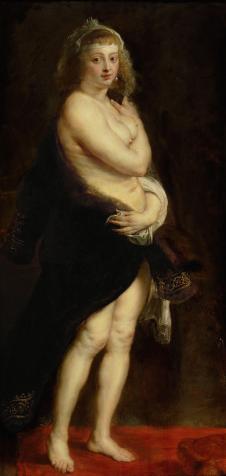
Bronze glows with the warmth of aged earth—this is Maillol’s *Little Venus*, not a painting but a compact, standing nude carved in bronze, its surface alive with the quiet pulse of classical restraint. She stands rooted yet weightless, arms folded gently across her torso, head tilted just enough to suggest inward reflection rather than outward address. There is no drama here, no theatrical gesture—only the serene authority of form held in perfect equilibrium.
The composition is profoundly architectural: broad hips anchor the figure, shoulders echo their curve in softened counterpoint, and the columnar neck rises without strain toward a face reduced to gentle planes—no sharp features, no narrative eyes, only presence distilled to essence. Maillol’s chisel work leaves subtle traces—soft transitions between volumes, no hard edges, no frantic detail—so light flows over her like water over stone, catching along the swell of abdomen or the quiet hollow beneath the clavicle. This is not realism in the descriptive sense, but *truth* in the sculptural one: anatomy subordinated to rhythm, proportion elevated to poetry.
Rooted in the late currents of Art Nouveau yet pointing firmly toward early modernism, *Little Venus* embodies Maillol’s lifelong rebellion against Rodin’s emotional turbulence—choosing instead the enduring calm of Cycladic idols and Roman matrons. Her brown-gold patina deepens the sense of timelessness, while her full, unhurried volumes evoke fertility, stillness, and elemental dignity. More than a study of the female nude, she is a meditation on permanence—sculpted silence made visible, and one of the most resonant distillations of 20th-century neoclassical sensibility.