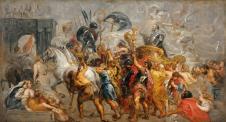
A hush settles over the scene—not the silence of abandonment, but the deep, resonant quiet of time made visible. The Arch of Titus stands fractured yet unbowed, its broken archway and eroded reliefs holding space with stoic dignity. Figures move through the ruins not as mourners or tourists, but as quiet inhabitants—small, unhurried, their presence softening the grandeur of decay into something intimately human.
Piranesi’s etching masterfully deploys black-and-white tonality to sculpt volume, depth, and texture without a single hue. Deep, velvety shadows pool beneath column bases and within the arch’s hollow throat, while crisp highlights flicker across surviving cornices and the faint, slanted gleam catching stone fissures. His line work is both precise and alive: tight cross-hatching suggests weathered marble grain; looser, rhythmic strokes evoke creeping ivy and the drape of linen cloaks. This is Baroque draftsmanship at its most intellectually charged—dramatic in conception, meticulous in execution, and deeply tactile in effect.
The composition resists symmetry, positioning the arch slightly off-center to open breathing room on the left—a field of rubble and suggestion that draws the eye forward and then upward, along the subtle choreography of figures, toward the arch’s enigmatic interior void. Here, Piranesi transforms architectural ruin into philosophical terrain: the contrast between enduring stone and fleeting life isn’t oppositional, but dialectical. His *veduta*—a view rooted in observation—becomes a meditation on memory, resilience, and the quiet continuity of daily existence amid imperial collapse. As one of his most psychologically nuanced Roman ruins etchings, it bridges Enlightenment empiricism and Romantic sensibility, securing its place among the defining images of eighteenth-century printmaking.