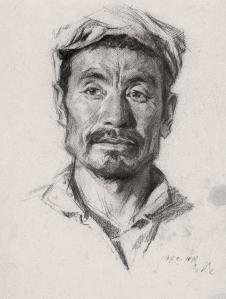
A woman’s face emerges from the paper not as a finished ideal, but as a living negotiation between pressure and restraint—her gaze steady yet withdrawn, her lips softly closed, her brow calm beneath the restless architecture of dark, coiling hair. Anders Zorn treats this *Female Portrait Study* not as a demonstration of technical mastery alone, but as an intimate act of attention: every decision—from the abrupt halt of a line to the deliberate thinness of ink on cheekbone—is calibrated to reveal character through texture, not ornament. There is no background, no symbolic attribute, no gesture of status or sentiment—only the taut, breathing presence of a human head and shoulders, held in sharp focus by the very economy of means.
Zorn’s color technique here is paradoxically rich despite its monochrome discipline. He works entirely in black ink and the warm, unbleached tone of the paper—a restrained palette that he transforms into a resonant spectrum of grays, umbers, and silvery veils. Rather than layering transparent glazes as in oil, he manipulates density and surface topography: deep, velvety blacks are built up through multiple biting and careful wiping of the copper plate, while highlights bloom not from added white pigment but from the untouched paper itself—exposed with surgical precision where light would catch the curve of a temple or the ridge of a collarbone. His scumbling is tactile and deliberate: broad, dry strokes across the fur collar generate a soft, fibrous opacity, while broken brushwork (though executed with burin and scraper) mimics the flicker of light across uneven surfaces—each interruption in tone suggesting movement, breath, even warmth.
The physicality of the paint—or rather, the ink’s material behavior—is central to the work’s quiet intensity. Zorn applies ink thickly in areas like the dense mass of hair, where heavy etching creates ridges that hold pigment like miniature valleys, yielding a palpable impasto-like relief when printed. Elsewhere, especially across the forehead and jawline, he uses feather-light wiping and delicate drypoint burr to coax out transitions so subtle they seem breathed onto the surface—thin, translucent passages where the paper’s natural tooth and warmth bleed through the ink, producing a skin-like luminosity. This contrast—between the plush, almost sculptural weight of the collar and the diaphanous delicacy of the face—is not merely compositional; it is philosophical. It reflects Zorn’s abiding interest in authenticity over artifice: how truth resides not in polished surfaces, but in the variegated textures of lived experience—the roughness of wool, the elasticity of hair, the fragile translucence of human epidermis.
What lingers is not the likeness alone, but the intelligence behind its making—the way Zorn’s hand moves *with* anatomy rather than over it, guiding the eye along the slant of a zygomatic arch, pausing where light fractures at the edge of a curl, retreating just enough at the corners of the eyes to preserve their enigmatic reserve. His broken line work doesn’t describe contour so much as trace the nervous energy beneath it: a hairline that lifts and separates like live filament, a shadow under the chin rendered not as solid tone but as a cluster of hesitant, vibrating marks. Within the German Renaissance tradition of precise portraiture, Zorn carves out a singular voice—one that honors Dürer’s linear rigor while infusing it with a distinctly modern empathy, one that sees dignity not in grandeur, but in the unvarnished grain of being. This study remains notable not for what it shows, but for how insistently, tenderly, it *feels*.