This artwork may be protected by copyright. Download is for study & reference only — not for commercial use. If you are the rights holder and object to its display, click here to report and we will remove access within 24 hours.
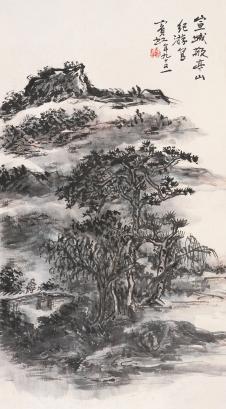
Material Introduction This painting "Layered Mountain Desert Landscape" takes the vast and desolate northwestern terrain as its theme, depicting undulating bare mountain ridges and low adobe villages built along the slopes, presenting a borderland ecology that is sparsely populated yet resiliently enduring. The picture has no clear narrative figures, yet through empty paths, wind-eroded walls, and low-hanging light, it quietly tells the silent and profound relationship between the land and its people. The overall visual atmosphere is solemn and introverted, with both the solemnity of desolation and a kind of almost divine, serene power.
Composition The painter uses a variation of the classic "three-distance method" composition. The foreground opens with a slightly sloping dry slope to create depth, the middle ground features villages embedded like stones in the mountain folds, and the background consists of several progressively blurred gray-blue mountain ranges pushing toward the sky, forming a clear rhythm of distance. The visual focus falls on the mountain hollow in the upper left of the middle ground—two side-by-side beige adobe houses and a winding path form a subtle visual anchor, guiding the eye from near to far, from solid to void, wandering among the layered mountain forms.
The mountain contours are rigid and rhythmic, with the horizontal extension and the vertically compressed sky together reinforcing the vastness of the earth and the heaviness of time.
Painting Appreciation This work transcends the faithful reproduction of natural forms, using a highly condensed formal language to construct an existentialist landscape philosophy: the desert is not dead but bears the most authentic weight of life through its rough texture and calm colors. The layering of mountains not only presents geological structure but also metaphorically represents the sedimentation of memory, time, and history.
Although the village is simple, it emits a warm beige glow within the gray-brown tone, giving the entire picture a tension of warmth within coldness. Its artistic value lies in using minimal visual elements to evoke deep resonance in the viewer regarding land ethics and resilience.
Technique The painter's brushwork is steady and varied. The mountains are rendered with a broad palette knife to create a coarse texture, simulating the rock layers eroded by wind and sand. The village buildings are outlined with fine, dry brush strokes, with windows and...