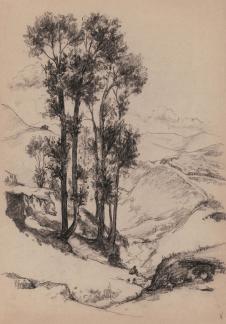
A sun-dappled path cuts diagonally through the frame—not as a rigid vanishing point, but as a breathing invitation, its softened edges and irregular stone slabs guiding the eye with quiet insistence into a luminous, leaf-filtered depth. The trees flank it like attentive, slightly off-kilter sentinels: their trunks tilt just enough to suggest breeze and growth, while their crowns dissolve not into botanical precision but into buoyant clusters of elliptical greens and water-drop silhouettes—shapes that feel both digitally precise and tenderly hand-guided. This is landscape as lived perception, not surveyed terrain; Hockney treats the woods not as subject to be rendered, but as a field of optical events—light catching a wet stone, a shift in hue where shadow meets sunlit foliage, the fleeting pulse of new life.
Hockney’s palette here is structural, not ornamental. Green isn’t background—it’s a living spectrum: lime-kissed yellows ignite the upper branches, while cooler, greyed celadons pool in the hollows of trunks and recede into misty distance. Pink appears not as floral decoration but as atmospheric punctuation—soft, chalky blooms muted with flecks of米白 and whisper-thin green, so they hover rather than sit. Yellow is never brash; it’s an eggshell-soft鹅黄, edged with verdancy, flickering at leaf tips and along the path’s sunlit seams. These hues don’t sit side by side—they interpenetrate. Thin digital glazes mimic watercolor’s capillary bleed, letting underlying tones shimmer through translucent layers, so that a patch of嫩绿 seems lit from within by the very light it filters.
The physicality of color reveals Hockney’s enduring fascination with how vision constructs space—and how technology can extend, not replace, tactile sensation. His brushwork is absent in the traditional sense, yet the surface pulses with a deliberate, almost palpable tactility: edges blur with controlled softness, mimicking unfocused glances or light diffusing through humid air; highlights bloom with the gentle insistence of pigment laid wet-on-wet, even when generated algorithmically. This isn’t nostalgia for analog media, but a recalibration—using digital tools to achieve the spontaneity of watercolor’s bloom and the chromatic intelligence of Post-Impressionist structure. In *Spring Path Through the Woods*, color doesn’t describe spring—it generates it, molecule by molecule, pixel by pixel, in a sustained act of joyful, rational wonder.