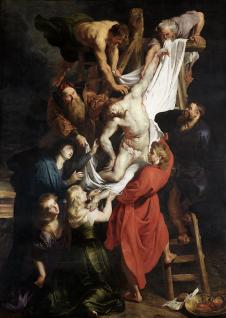
A shaft of divine light pierces the gloom—not from heaven’s distance, but as if summoned by grief itself—bathing Christ’s lifeless form and the hushed circle of mourners in a stark, radiant pool. This is Rembrandt’s *Christ Descending from the Cross*, a masterful etching that distills Baroque intensity into black-and-white ink. The scene breathes with solemn stillness: no gesture is exaggerated, yet every bent knee, every lowered head, every taut forearm speaks volumes about shared sorrow and sacred duty.
The composition pivots on quiet geometry—the diagonal of the cross recedes gently, while the horizontal line of Christ’s body anchors the image like a fallen altar. Rembrandt’s etching technique achieves astonishing subtlety: fine, trembling lines define the texture of coarse linen and weathered skin, while deep, velvety blacks swallow peripheral space, focusing attention with almost theatrical precision. Light doesn’t merely illuminate—it consecrates, carving volume from shadow, softening edges where reverence meets mortality. You feel the weight of the body not through strain, but through the collective stillness of those bearing it.
This etching stands apart in Rembrandt’s graphic oeuvre for its fusion of Dutch Reformed austerity and Catholic-inflected pathos—a rare convergence in his later religious works. Its emotional gravity arises not from spectacle, but from intimacy: the viewer stands close enough to see the tremor in a wrist, the hollow beneath a collarbone, the quiet surrender in a closed eye. As a pinnacle of chiaroscuro printmaking, it demonstrates how profound narrative depth can emerge from monochrome restraint—proving that spiritual resonance needs no color, only conviction.